The Infosec Wheel — Building a Map for the Next Generation of Security Professionals

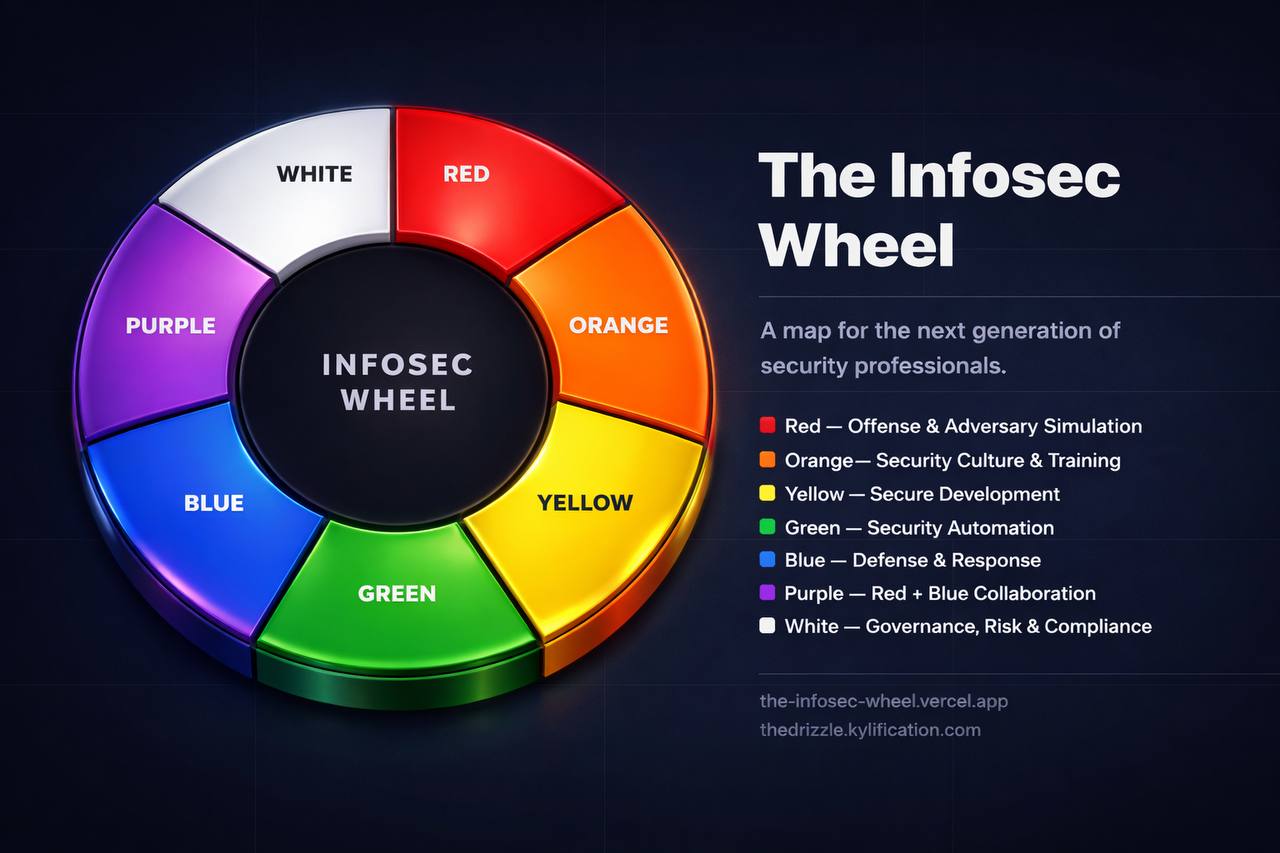
I wished something like this existed in 2015
In 2015, I was grinding through job applications trying to break into cybersecurity. I had some experience, some passion, and exactly zero clarity on what roles actually existed, what tools each team cared about, or how the industry was even structured. I was failing interviews and I didn't fully understand why.
So I did something that changed the trajectory of my career — I started asking. Not just applying and moving on, but literally asking hiring managers: "What feedback would you give someone like me trying to land an entry level role?" and "What advice would you give to make me stand out?"
Most people don't ask. I did. And I got answers that I still reference today.
That willingness to ask uncomfortable questions, to be vulnerable about what I didn't know — that's what unlocked things for me. But I also got lucky. I got lucky that people answered. I got lucky that I met the right people at the right time. A lot of people trying to break into cyber don't get that same luck, and I think about that a lot.
Mentorship isn't a checkbox
I've been fortunate to be embedded in Disney's mentorship programs for years now — as a mentor, a mentee, and a peer mentor. Those relationships aren't transactional for me. Over the last few years, the teams I've worked with have had early career folks who I was lucky enough to see go from interns and contractors to full-time roles at Disney. I meet regularly with people trying to figure out how to break in, how tech works, how to navigate the hiring process.
Every single time I meet with someone early in their journey, I think about 2015 Kyle. The one who didn't have a clear map. The one who had to learn the hard way that "cybersecurity" isn't one job — it's dozens of disciplines, each with its own toolsets, certifications, and culture.
And that's the problem I wanted to solve.
The Infosec Color Wheel
Most people in security have heard of Red Teams and Blue Teams. Fewer people know about the full color wheel — a framework introduced by April C. Wright at Black Hat in 2017 that expands the Red/Blue model into seven distinct domains.
Each color represents a team, a mission, and a set of tools and roles:
| Team | Mission | Example Tools |
|---|---|---|
| 🔴 Red | Offensive testing, adversary simulation | Metasploit, Cobalt Strike, Burp Suite |
| 🟠 Orange | Developer security training, awareness | OWASP WebGoat, HackTheBox, TryHackMe |
| 🟡 Yellow | Secure development, AppSec, DevSecOps | Semgrep, Snyk, SonarQube |
| 🟢 Green | Security automation, detection-as-code | Shuffle, XSOAR, Sigma |
| 🔵 Blue | Defense, incident response, threat hunting | Splunk, CrowdStrike, Zeek |
| 🟣 Purple | Red+Blue collaboration, control validation | MITRE Caldera, Atomic Red Team |
| ⬜ White | GRC, compliance, policy, oversight | Vanta, Drata, ServiceNow GRC |
Check out the live interactive version: the-infosec-wheel.vercel.app
Click any segment and it shows you the tools, teams, and career roles that live in that domain. That's the map I wish I'd had in 2015.
Why this matters for early career folks
When you're trying to break into cyber, the internet gives you the same three answers: get a Security+ cert, learn Python, do TryHackMe. That's not bad advice, but it's incomplete. It doesn't answer the question where do I actually want to go?
The color wheel answers that. You might be a builder at heart — that's Yellow/Green. You might love the puzzle of hunting for attackers — that's Blue. You might want to get paid to break things — that's Red. You might care more about policy and governance and organizational risk — that's White.
Knowing the landscape changes how you invest your time. Instead of studying everything and feeling overwhelmed, you can pick a color and go deep. Find the certifications that map to it. Find the tools to get hands-on with. Find the job titles to search for.
That's the point of this project — not just a tool directory, but a compass.
How this was built — and why that's also part of the story
Here's the part I didn't plan to write about but felt too relevant to leave out.
This entire project — the research, the code, the deployment, every commit — was built fully autonomously from my phone. No laptop. No IDE. Just a Telegram chat with Claude Code running on my desktop in the background.
The conversation went from "let me do some research on the market first" to a fully deployed production app with:
- Deep market research on competing sites and existing catalogs
- A complete data model with 7 color teams, 70+ tools, roles, and certifications
- An interactive SVG wheel with click-to-expand and half/full view toggle
- Tool detail panels with tabs for Teams, Tools, and Roles
- A community submission flow backed by GitHub
- Git Flow with semantic commits, feature branches, develop, and main
- A Vercel deployment and a Semgrep CI security scan (0 findings)
All of it — from the first "Hey" to the last npx vercel --prod — happened in a single session, from my phone, via Telegram.
I'm not sharing this to be impressive about the technology. I'm sharing it because it changes what's possible. The gap between "I have an idea" and "there's a live product" is collapsing. That matters for builders. It especially matters for early career people who want to build a portfolio but feel blocked by the technical complexity of standing something up from scratch.
This blog post was written with AI too
I'll be honest about this: this is my first blog post written with AI assistance. I gave Claude my previous posts, explained what I wanted to say, and answered a few questions about my own experiences. What came back was something I edited, shaped, and made mine — but the first draft wasn't blank.
I think about this the way I think about the infosec wheel project. It's not about replacing the human. It's about what becomes possible when you remove the friction. I still had the idea. I still had the story. I still had the 2015 experience and the Disney mentorship moments. The AI didn't invent any of that — it just helped me get it out of my head and onto the page faster.
That's the use case I wanted to demonstrate: building a product, writing documentation, writing a blog post. Three different kinds of creative and technical work, all done through a phone and a chat window.
Running Claude Channels securely — what I learned
Building a full production app from your phone via Telegram sounds exciting. And it is. But if you're going to run Claude Code as a remote agent connected to a Telegram bot with access to your local machine, your repos, and your deploy keys — you need to think about this like a security person.
Here's what I put in place and what I'd recommend.
Lock the bot to your user only
The Claude Channels Telegram plugin uses an access.json file to manage who can interact with your bot. By default, if someone gets your bot token, they can send messages to your Claude Code session and execute arbitrary commands on your machine.
The fix is simple but critical: restrict the allowlist to your own Telegram user ID (and any trusted groups) before you start using it. The plugin supports user-level and group-level access control. Set it up before you do anything else.
If someone gets in — even accidentally — they're not just reading your chat. They're potentially running code, accessing your file system, and pushing to your repos.
Verify before you execute
Claude Code has a permission model: before it writes a file, runs a command, or pushes to GitHub, it shows you what it's about to do and asks for approval. In Telegram mode, that approval flow comes back to your phone.
This is human-in-the-loop by design — and it matters more than it sounds. I caught it in the act during this build.
At one point, Claude proposed a git push --force to resolve a branch conflict. I denied it, told it what I actually wanted, and it corrected course. That one denial probably saved me from overwriting commits I cared about. Force pushes to shared branches are the kind of action that's hard to undo — and the kind of thing an AI agent under time pressure will reach for as a path-of-least-resistance fix.
The lesson: don't just read what the AI proposes. Read it like a code reviewer. You're approving real shell commands with real consequences.
A few patterns I now follow:
- Deny anything with
--force,--no-verify, orrm -rfunless I specifically asked for it - Read commit messages before approving pushes
- Question any command that touches credentials, env files, or CI config
Claude Channels vs. OpenClaw
If you've been in the autonomous coding agent space, you may have come across OpenClaw — an open-source framework for running AI coding agents locally via various interfaces including chat-based triggers.
Here's how I'd compare the two approaches:
| Claude Channels (Telegram) | OpenClaw | |
|---|---|---|
| Model | Claude (Anthropic) | Open-source, model-agnostic |
| Interface | Telegram bot | Various (web, CLI, chat) |
| Access control | Allowlist via access.json | Depends on deployment |
| Permission model | Per-tool approval prompts | Varies by config |
| Setup complexity | Low — plugin + bot token | Higher — self-hosted |
| Transparency | You see every tool call | Depends on UI |
| Cost | Claude API usage | Model-dependent |
The biggest practical difference in my experience: Claude Channels keeps the human in the loop at every significant action. The approval flow isn't optional — it's the default. OpenClaw and similar open-source agents can be configured for full autonomy, which is powerful but shifts more responsibility onto you to set guard rails.
For a security practitioner specifically, I'd argue the Claude Channels model is actually the more defensible one to start with. You build up trust in the agent's judgment one approved action at a time. You learn what it does well and where it reaches for risky shortcuts. Then you decide — intentionally — how much autonomy to grant over time.
Trust but verify. Especially when the thing you're trusting has shell access to your laptop.
If you're early in your career in security
Ask for help. Ask the uncomfortable questions. Find the people who will actually answer and don't let those conversations be one-directional.
Pick a color. Not forever — just for now. Go deep on the tools and certs and community in that domain. Build something small. Write something. Ship something. The reps matter more than the credentials.
And if you're someone who's figured some of this out — pay it forward. The 2015 version of someone you know is out there, failing interviews, not sure why, too proud to ask.
Be the person who answers.
🎯 Explore The Infosec Wheel → 🐙 GitHub — the-infosec-wheel ➕ Submit a tool or role to the community catalog